Upcoming Events
September 24, 2026
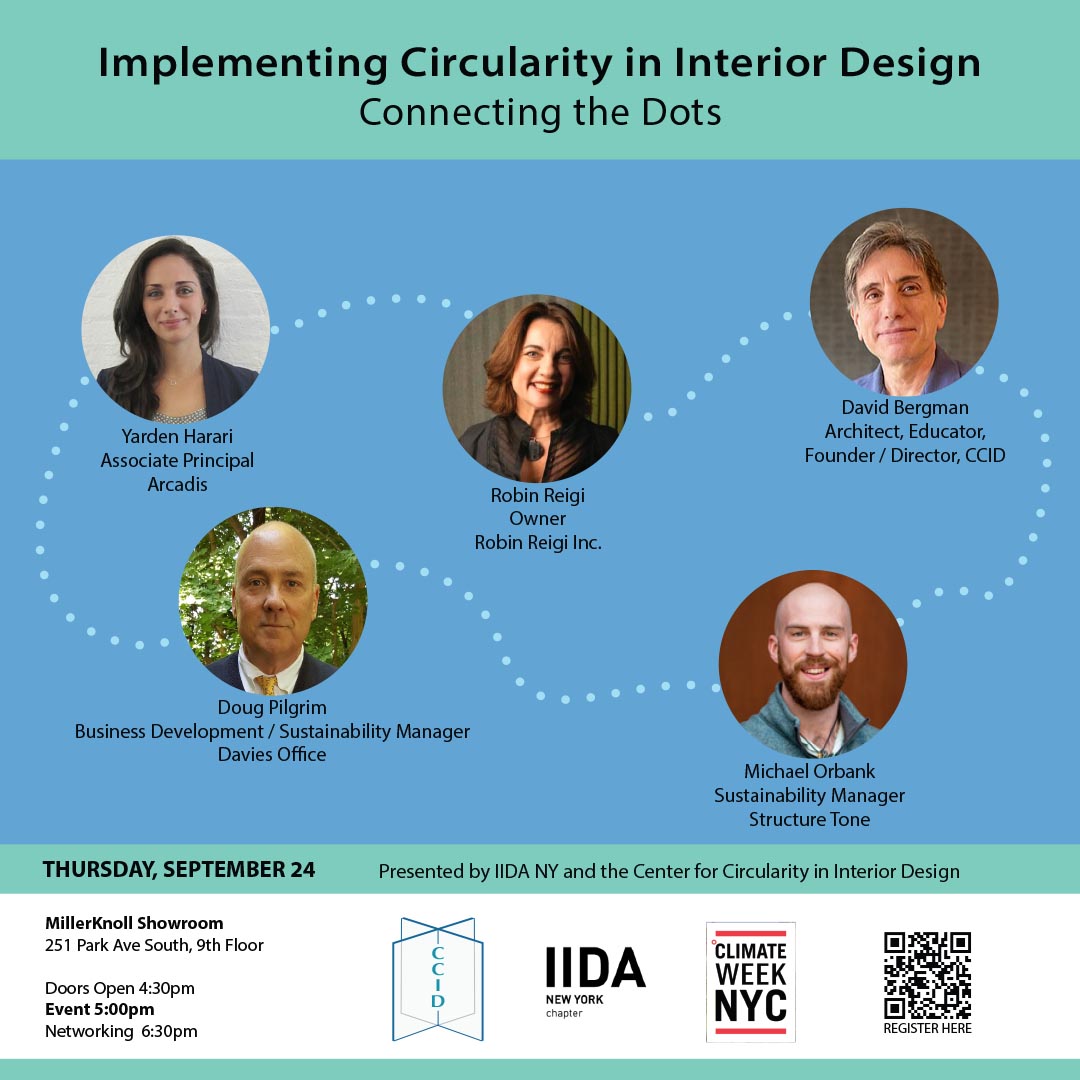
Our interior spaces remain trapped in a persistent and costly loop system of frequent renovation, demolition, and disposal, resulting in an unsustainable churn of materials. While circular design offers a path forward, the challenge isn’t only just designing for circularity; it’s creating the network of relationships needed to make it work: connecting the many stakeholders responsible for shaping, operating, and renewing interior spaces.
Our panel of stakeholders across the value chain will examine what is needed to effectively implement the circularity loop to keep materials in circulation, reduce waste, lower costs, create jobs, and transform the interiors industry from a linear model of consumption to a truly circular one. Join us for a lively and provocative discussion.
Greenbuild 2026 – stay tuned for details

2026 Deconstruction + Reuse Conference
Phoenix, AZ
“How to Fix the Missing Links in Interiors Circularity”
The critical importance of implementing and scaling circularity in all of interior design’s phases has been discussed for a few years now. So why isn’t it happening yet? A great deal of the reason is that the loop has too many missing connections. One missing link is that it’s currently very difficult for interior designers to find, specify and procure salvaged and remanufactured materials and products. Designers are used to going to showrooms and having reps come to their office. For the most part, there aren’t showrooms, reps or reliable sources to turn to. Related to that is quality assurance, certifications, and warranties, which, for the most part, do not exist. Another difficulty is timing. It’s often the case that there is a significant period between design and delivery. Often times, items go in and out of availability.
Yet another missing part is that post-use recovery needs to be enabled. For that to work well, Design for Deconstruction (or Design for Disassembly in the case of some types of products) has to be considered in all design phases, as does as-built inventorying or materials passports of everything that goes into a project. But what exactly does that entail?
Our panel will consist of an interior designer, a deconstructor, and a reseller or remanufacturer, moderated by the Director of the Center for Circularity in Interior Design. We will be discussing concrete steps needed to enable simpler and more widespread adoption of circularity by connecting the dots in the circularity loop.
Speaker
David Bergman, Center for Circularity in Interior Design, Founder and Director
New York School of Interior Design, Program Director. MPS Sustainable Interior Environments
Co-speaker/panelist
Eric Doyle, Steelcase Inc., Global Sustainability
Panelists
Jenn Chen, Our Found Future, Consultant
Stephanie Bonic, Ouroboros, Director of Operations